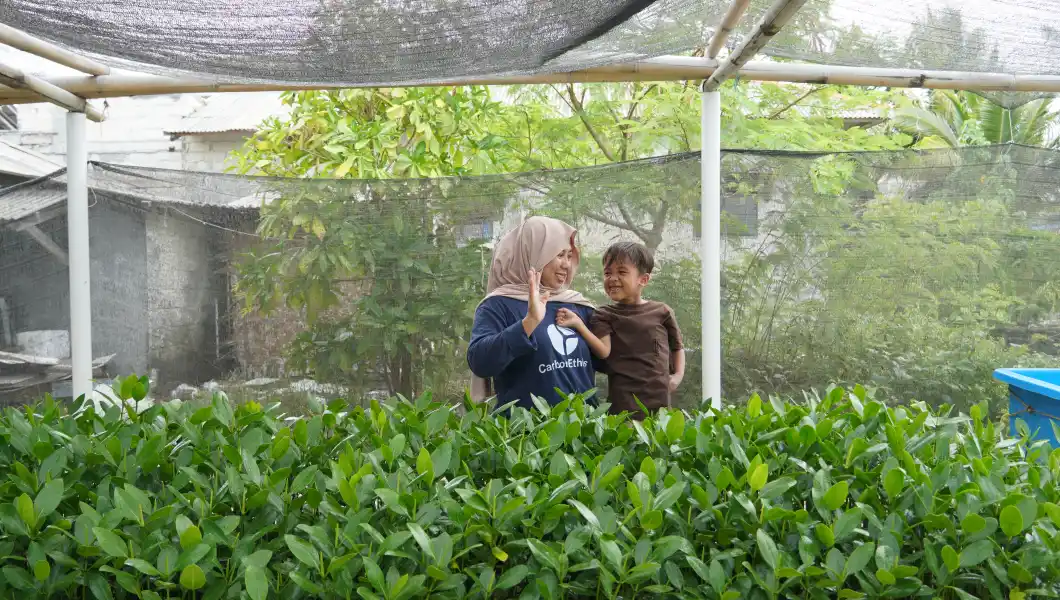
Mangrove Rehabilitation and
Community Development -
West Java
Community Development -
West Java
Location
Tanjungpakis, Karawang
Regency, West Java
Type
Nature-based solutions and
community empowerment
Supported by


SGDs Supported
.webp)
Project Overview
Tanjungpakis, once known as the "Dollar Village" for its thriving economy, is a coastal community with a rich cultural and natural heritage. Over time, the village has faced challenges such as coastal erosion, illegal sand mining, and changes in biodiversity. Situated at the mouth of the Citarum River, the village is home to the Sunda-Betawi Tribe and a wide variety of species.
This project aims to address environmental challenges through nature-based solutions that integrate ecological restoration with socio-economic empowerment. By planting mangroves, installing wavebreakers, and developing sustainable livelihoods, this initiative not only protects the coastline but also fosters resilience among the local population.
.webp)
The Impact
.webp)
Community Empowerment
Partnerships with the Elang Laut Farmers Group and KAWANIBU Women's Group have enabled the development of mangrove-based products, including batik dyes, soaps, and crafts, creating alternative livelihoods. Collaborations with organizations like Planet Ban and RMIT University have brought technical expertise to enhance resilience, from wavebreaker installations to seawater desalination research.
.webp)
Public Infrastructure
Additionally, we've improved infrastructure through public road refurbishments and cooperative investments, ensuring the benefits of our work are widely shared. Each initiative contributes to a model of sustainable development, demonstrating how ecological restoration and community empowerment go hand in hand to create lasting change in Tanjungpakis.
.webp)
Environmental Impact
Through our mangrove rehabilitation program, we have planted 31,460 mangrove trees, restoring 2.21 hectares of degraded land and sequestering 2,120 tons of CO2 over 20 years. These efforts protect the coastline, support marine biodiversity, and strengthen local fisheries. To further combat erosion, we installed four wavebreakers, safeguarding both the environment and the livelihoods of the coastal community.
.webp)
Waste Management
We've implemented waste management solutions, including beach clean-ups that collected 290 kilograms of waste and the establishment of a central waste bank, creating a sustainable recycling system. Community empowerment has been central to our mission, with 18 thematic training sessions benefiting over 5,600 individuals. These programs have equipped residents with skills in sustainable aquaculture, mangrove-based product development, and ecosystem restoration, resulting in an 87% income increase for participating farmers.
Community Empowerment
Partnerships with the Elang Laut Farmers Group and KAWANIBU Women's Group have enabled the development of mangrove-based products, including batik dyes, soaps, and crafts, creating alternative livelihoods. Collaborations with organizations like Planet Ban and RMIT University have brought technical expertise to enhance resilience, from wavebreaker installations to seawater desalination research.
Public Infrastructure
Additionally, we've improved infrastructure through public road refurbishments and cooperative investments, ensuring the benefits of our work are widely shared. Each initiative contributes to a model of sustainable development, demonstrating how ecological restoration and community empowerment go hand in hand to create lasting change in Tanjungpakis.
Environmental Impact
Through our mangrove rehabilitation program, we have planted 31,460 mangrove trees, restoring 2.21 hectares of degraded land and sequestering 2,120 tons of CO2 over 20 years. These efforts protect the coastline, support marine biodiversity, and strengthen local fisheries. To further combat erosion, we installed four wavebreakers, safeguarding both the environment and the livelihoods of the coastal community.
Waste Management
We've implemented waste management solutions, including beach clean-ups that collected 290 kilograms of waste and the establishment of a central waste bank, creating a sustainable recycling system. Community empowerment has been central to our mission, with 18 thematic training sessions benefiting over 5,600 individuals. These programs have equipped residents with skills in sustainable aquaculture, mangrove-based product development, and ecosystem restoration, resulting in an 87% income increase for participating farmers.
Project Highlight
.webp)
.webp)
.webp)
.webp)
.webp)
.webp)
.webp)
.webp)
.webp)
.webp)
.webp)
.webp)